Monday, 19 February 2018

Pitchers Galore.....


We have lots of different pitchers in our collection and several of them are basket weave.  We also have pitchers made by Medicine Hat Potteries and Alberta Potteries, I have shared photos of all the different potteries.  Some of them are decorated, some have advertising and some are just a pitcher.  There are several sizes and a few different shapes.


This blog will feature basket weave pitchers made by Medalta, I will provide information about the basket weave pitchers in this blog and will talk about some of the other pitchers in later blogs.  I have included photos of other pitchers by other companies as well.

The photos are all pieces in our own collection. 


“Basket Weave Pitcher” (1938-ca.1945)  (Copied with permission of the writer)
.5, 1, 1.5 & 2-pints
This is the only pitcher made by Medalta to which a style number was assigned, but even though it was given No. 84 it was more commonly referred to as the B/W Pitcher in the Medalta records.  While we do not have a firm date for the introduction of this product, it was either late 1937 or early 1938 as indicated by a letter dated July 2, 1938.

These pitchers must be as described, that is with the basket weave part in helio, crimson or green and the rest of the pitcher in cane.  ...The original sample which Mr. Cunliffe submitted to us last winter was in two colors and that is the type of article required.”  By March 1938 you start to find orders for the basket weave pitcher, and although the records are skimpy you still find this pitcher being sold in 1945.

As typical for mould-made pitchers of this period, the style number and size are impressed in the bottom of the pitcher. You do find “Medalta” impressed as well but it seems to be quite erratic. You can find many examples in various sized pitchers where the Medalta name is either absent or perhaps just obliterated. On the other hand most pitchers, even the ones with the impressed Medalta name, are well marked with an oxide stamp.

The sizes were not the usual ones but rather the 1/2, 1, 1.5 and 2-pint pitchers. Medalta’s larger 3-pint size for which there was little demand had been dropped while the smaller 1/2-pint size had been added to keep the pitcher as a four piece set. In this style of pitcher the size is usually followed with the pint abbreviation “PT.”


The colours and decorations used on this pitcher were quite varied. The Marshall-Wells catalogue for 1940 advertised the available colours as cane, crimson, helio and green. In a letter dated 20 December 1941, Medalta advised the Hudson’s Bay Company of Winnipeg that the “colours are cane, teapot brown, green and crimson.

The two-tone pitchers as requested in the letter quoted above are also found, as are ones with the stencilled cows and cottage decorations. And you can also find pitchers with a floral decoration around the top of the pitcher.  They must have had a large number of moulds for the making of this pitcher, and in all likelihood they changed through time although I have not yet tried to identify or document these changes. My reasons for saying they exist include the fact that the style number can be found as just the number “84” or as “No. 84”. In one example, a half-pint pitcher, the “4” was backwards. It is hard to imagine how this could have happened but it did!

If you check the heights and/or diameters of any given size of pitcher you will also find great variability, perhaps another indication that the moulds were changed. Also as the handles were applied, you will find a great range in the shape of the handle and where it was applied to the body.  It appears that all sizes of this pitcher were used as advertising premiums, although it was not selected as a premium too often. Only some six or so occurrences have been recorded so far, covering general stores, a dairy and a hotel. In addition, it was used by The Hanna Cooperative Association to advertise Ogilvie’s products, and if used by one store, other stores will undoubtedly show up in time. The advertising is invariably located at the top on the smooth portion of the pitcher.

One request that came Medalta’s way is recorded in letters dating to October 1938. The plant advised the head office in Calgary that “H.H. Schneoder is interested in a basket weave pitcher, with a cow or house decoration and his own name on the other side.” to which the head office replied on October 11th:  “Replying to yours of the 9th in connection with Mr. Schneider requiring some basket weave pitchers, decorated and his name stamped on the side, you will use your decorated prices for this item G38/3, G38/10, and add 2c per article for stamping. The cost of the stamp is to be paid by Mr. Schneider.  If this man intends giving these away in place of Calendars or some such item, it will be in order for you to give him a discount of 50%, and you will have to explain to him that this discount is only given under these circumstances. In other words if the pitchers are for resale the discount rate of 40% will apply.”  This letter illustrates several points. Firstly, I am not sure of the spelling of the Merchant’s name as each letter gives a different spelling. Eventually, that is if an order was even placed, one of these pitchers will show up and hopefully that will give us the merchant’s name and perhaps the location of his store. It also shows that the merchant was charged for the cost of the rubber stamp and extra for the actual stamping. Lastly it shows the discounts that were available depending on whether or not the item was a giveaway.


Two years ago in March I was wondering what could I do to try and start a dialogue with other collectors of Western Canadian pottery.  I was unsure of exactly what to but I thought a blog to share some of what we have found and the stories behind the pieces might be a place to start.  I was never sure how to reach people and so after many months of writing a blog with just a hand full of people reading it I tried several things to reach more people, now there are anywhere from 50-300 people reading each blog, I think it may depend on the subject and if the pictures create an interest.  Mostly the blog has been good for me as it has caused me to read more, do more research and talk to more people about what is out there.


Thank you for reading the blog and please let me know if there is a subject or specific pieces you would like to know more about.  I am not an expert but I will do my best to find whatever information I can and share it with you.

The Search Continues....... 


Thursday, 1 February 2018

Plates, plates and more plates.......

We picked up an entire collection last summer and it included many plates made by Hycroft.  What to do with so many plates???  Why use then of course!

These links will take you to some interesting history on Hycroft China:

https://hermis.alberta.ca/ARHP/Details.aspx?DeptID=1&ObjectID=4665-0490

https://albertaonrecord.ca/hycroft-china

So we did decide that the plates were very pretty, too pretty to stack away in storage so we put them into the cupboard and use them every day.  There is quite a mixture of patterns so we use different ones almost everyday.


  Custom made plates with names or initials in gold.


Plain colored ring around the edge of the plate and a bear with a forest scene and the plate s rimmed in gold trim.
Fifth Avenue Untied Church, Medicine Hat, Alberta and

Fort Garry Hotel, gold and blue rimmed plate.


FLAMINGO - No 506   Flamingo is found on the Balmorla or swirl edge style of dishes, and this is the main difference that separates it from its sister pattern Everglades. It was assigned pattern number 506 and Hycroft’s invoices indicate that sets were sold from 1955 to 1964. I have only seen it in one colour to date, that being a red hibiscus flower with leaves in several shades of green against                a  white background. The rim of the dishes is finished with a speckled gold band

Daizy: No Pattern Number The Daizy pattern is listed in
t h e  Hycroft Records  from 1964-1970, and on the invoices it is usually listed as Daisy not Daizy as on the Hycroft backstamp. Even though it was sold for some seven years, it apparently was not that popular a pattern judging by the number of times you find it listed in the Hycroft invoices; and, furthermore, you do not find it in the marketplace very often. (they are also handpainted)


Game Birds in Flight 
Holiday shape Commercial # ---, center spray, cut geese and partridge size for cups and saucers.  Hycroft China Backstamp. 1955-1979
(Copied from the original with the permission of the writer)
(All photos form our private collection)


Lots of photos of plates most of which are in our cupboard so each evening is a surprise which plate you get.  I must admit I do have a preference but I will never tell which one it is.  There are several photos that do not have the pattern name, I wonder if you have more information could you please name the plate on this page so I can put the names in a comment.


And the Search Continues....


Sunday, 14 January 2018

Marked or Not....

Like all collectors we have a number of pieces that are not marked but it is very apparent who made them.  Once we find a piece that is not marked it just makes us look harder to find one that is marked, and that is fun.

CARNOTT Art Wares  (copied with permission of the writer)
The Origin of the Name Solved
On page 16 of the booklet “Know Your Medalta: Vases” where I discussed CarNott 
artwares, I suggested that while the origin of this name was likely lost to us, it may 
have referred to a coloured lacquer finish; but, now thanks to an astute reader, we 
probably have the origin solved.   John Shairp put two and two together noting that  
the new owners of the plant in 1929, just before Medalta introduced its artwares, 
were named Reginald C. Carlisle and O. Clair Arnott. What could be simpler than 
the origin of CarNott as coming from “Car” in Carlisle and “Nott” in Arnott? Thank
you John for not only spotting the association that was not obvious to me but also
 for bringing it to my attention. 

The birds we have are not marked but you can see them in a photo in Ron Getty's "Know Your Medalta: Vase" on page 19.  There is a photo of a display of CarNott ArtWare and the bird is on the bottom right hand corner.  As yet we have not seen one that is marked, I am not sure if anyone else has had the pleasure of finding one that is marked in any way.

The birds were made in two different ways - some had holes in the base to make a flower frog and others did not and were just figurines.  One of our birds came with a bowl that appears like it was meant to be the bowl the flower frog bird sat in. 


There is a different bird in the same photo and as of yet we have not seen that one outside of the collection at the Medalta site in Medicine Hat.  The following photo is one that was taken at the Medalta Museum in Medicine Hat.


The same photo of the display also shows the polar bear and on the next page it looks like there is a photo of the same bear in brown.


I am adding a couple of links to internet pages that we have used and they have some great information.  We also use the books written by Ron Getty, they are an invaluable source of information for Medalta collectors.  There are several others but we tend to use Ron Getty's the most and often have them with us when we travel.

https://journals.lib.unb.ca/index.php/MCR/article/view/17142/22847

https://journals.lib.unb.ca/index.php/MCR/article/view/17156/22857

https://journals.lib.unb.ca/index.php/MCR/article/view/17062/22922

http://www.virtualmuseum.ca/sgc-cms/histoires_de_chez_nous-community_memories/pm_v2.php?id=story_line&lg=English&fl=0&ex=00000494&sl=4287&pos=1

And the Search Continues.......


Thursday, 21 December 2017

Merry Christmas One and All...


Another year has almost come to an end and I am sure most of us are celebrating Christmas with friends and family.  Growing up my family owned a small business and I remember my Dad looking at things to hand out to customers at Christmas, this would start in about September in order to get them in time.  Some years it was pens or calendars other years it was hats or ashtrays but there was always something to give away.


I am sure these cake plates were also made to give away to customers at Christmas.


Beginning in 1929 and continuing through to 1939, Toshach’s gave an advertising item to each of the families in and around Drumheller.  Each fall, in time for Christmas, his children helped deliver the premium to the door of his many customers.  I do not know what all the gifts were, or even if they were all pottery pieces, but most were.  Some were made by British firms including a bowl and a calendar plate, but Medalta made a good number of them.  


These included: 2-pint ship shape pitcher with scene of coal tipple for 1934; teapot with Toshach’s shoes slogan for 1935, 


mixing bowl shoes slogan for 1938; and, the diamond- shaped pitcher for 1939.


Medicine Hat Potteries produced a few with Season's Greetings such as the S.E. Gust store pitcher 


From our home to yours we wish you a very Merry Christmas and Best Wishes for 2018, may you have good hunting and find many treasures!

The last word is a song by The Hunter Brothers from Shaunavon, Saskatchewan.


And the search continues.........


(This blog has information on the items produced by Medalta.  The information is copied with the permission of the writer.  The photos are from our own private collection. )


Wednesday, 6 December 2017

Itty Bitty.......

This blog has information on the miniatures produced by Medalta.  The information is copied with the permission of the writer.


The photos are from our own private collection.  I have only included the information for the pieces that we have in our collection so as to show a photo of each piece.

Medalta had a long history of producing miniatures, starting at least in the early 1920’s and going right through until the plant closed in 1954.   Some have claimed that the miniatures were salesmen’s samples but, if so, there is no mention of the practise in any of the Medalta papers.  We do know that Medalta used its miniatures to promote the plant, giving them away to people visiting the plant and selling them as souvenirs to those that wished them, Many of the miniatures are marked with a Medalta stamp on the side or with the phrase “Compliments of….”


It just might be that His Royal Highness the Prince of Wales, the Duke of Devonshire and Governor General Lord Bung of Vimmy all received a miniature crock or churn when they visited the plant in 1919. Perhaps somewhere in an English museum, or perhaps even the Royal collection itself,
lies one of these little miniatures!


In total, Medalta made seven different miniatures.  All but the miniature Fez were used to promote the plant, while the story for the fez is that it was made to give to the delegates of a Shrine convention held in Medicine Hat in 1949.

The seven different pieces are listed below, along with their size and the approximate number of each recorded so far. Item size # seen   
                                                       churn 3.5 to 3.75" high                    8 
                                                       chamber pot 1.38 to 1.5" high         13
                                                       butter crock 1.5"  high                     1 
                                                       crock 2.5" high                                14 
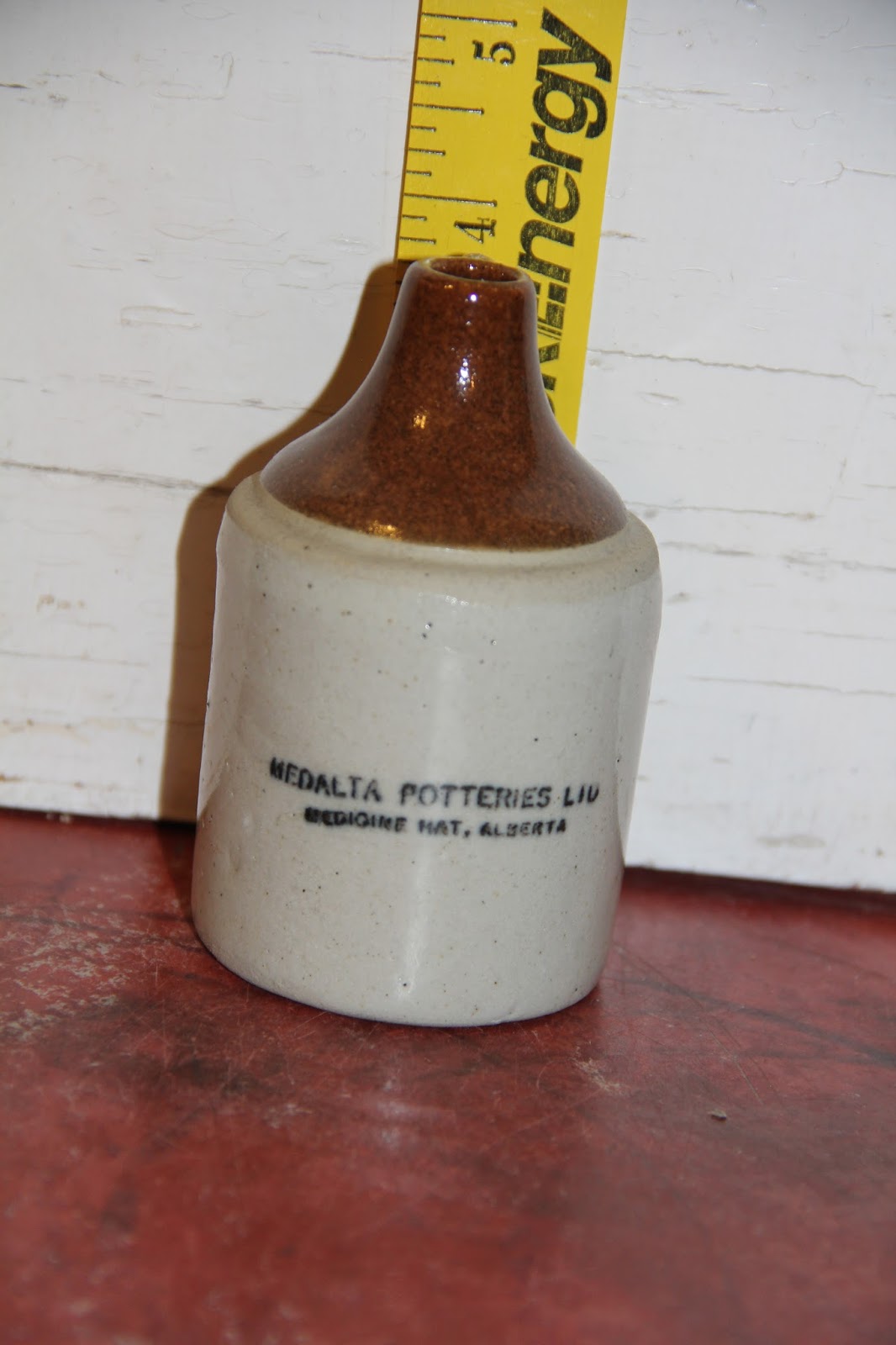
                                                       shouldered jug 3.75 to 4.0" high     54 
                                                       round top jug 3.38" high                 1 
                                                       saki cup 1.5" high                           1
                                                       fez 1.13  high                                   5


Churn

The  churn is perhaps the most prized of the miniatures, not only because it is early and hard to find, but also because of its graceful shape.  As to its date range, it is my guess that it was not made for many years, probably no later than 1930.


Chamber Pot

The chamber pot appears to have had a fairly lengthy period of production from about 1920 to at least the war but even so it is fairly hard to find.  The advertizing samples which have been seen include ones named to the Grand Council U.C.T. (also found on a jug), Marshall’s Books (located in Medicine Hat) and the Belleville Pottery Company in Ontario.  I do not know the date of the Marshall’s miniature but the other three were ordered in the second half of the 1920s.  The reason for extending the production date to the war years is that a letter dated April 1940 mentions the miniature chamber referring to it as a “pispot.”


 Saki Cup or Unhandled Chamber Pot
Once again I have recorded only one sample so therefore I cannot say much about it. It was marked on the bottom  with stamp no. G.14 and it was a dark wine in colour.  It likely dates around 1940 and perhaps it was intended to be used as a saki or Chinese tea cup.


Fez
The miniature fez or Shriner’s hat was likely a special order made only for the 1949 Shrine convention held in Medicine Hat. It was chosen as a memento of that occasion due to one of Medalta’s senior staff members being an active Shriner.


Shouldered Jug
After the pottery changed hands in 1924, with the name changing to Medalta Potteries Ltd., miniatures started to be
produced for anyone requesting them.  You can find orders for jugs placed by the I.O.O.F, National Hotel, Charles Baker, Grand Council - U.C.T. and the Athabasca Hotel (2 varieties Get the Broom & a bear design).
Some of the largest orders for miniature jugs during the mid to late 1920’s were placed by the Medicine Hat Pottery Company in Toronto.  They were the agents/distributors for Medalta’s products in the Toronto area from around 1925 to 1938.  The similarity in name to the pottery located in Medicine Hat led many collectors to pass on the opportunity of acquiring one of these jugs as they did not realize they were made by Medalta.  You can find the Medicine Hat Pottery Co. jugs with 2 different Toronto addresses and a variety of different layouts.  So far I have recorded at least four different varieties.

There is not much evidence of jug orders from 1934 to 1947, but in the late 1940s and early 1950s Medalta started making them again.  By this time Medalta was using its white burning clay rather than its grey stoneware clay.  The samples you can find include the Never Drink Water scene (a boy urinating into a pond) and the Cattle Country (saddle) and Mountain Trails (white-tailed deer) series.  In these series dating to the early 1950s, the miniature jugs were used as vinegar holders.


As a new collector it very exciting to find our first miniature piece to add to our collection.  We still have a few pieces to add in order to one of each of the miniatures produced by Medalta but the shelf is starting to fill up, the good thing is that they are small so the shelf will hold many of them.

Like always the fun is in the stories we hear and the people we meet.

And the search continues....


Thursday, 23 November 2017

Baby Sleigh, Donkey, Deer and More

This blog has information on the planters produced by Medalta.  The information is copied with the permission of the writer.


The photos are from our own private collection.


Whether it was Medalta or Medicine Hat Potteries that first came out with the animal and bird shaped planters may never be known, as the records from both companies are too few and far between. The majority of the Medicine Hat Potteries' records are still missing (the Friends of Medalta Society have a few but they take up less than two lineal feet) and the Medalta records are all but missing for 1938 and 1939 when these figurines first appeared which was also the formative years of MHP as most of you know.  I suspect that it was MHP which led the way, forcing Medalta to quickly follow suit, but admittedly I have no proof to offer at present other than to wonder why they were not introduced earlier if it was Medalta's own idea. This article is about Medalta's figurines only as I do not have the space to illustrate the products of the other companies at this time. The competition's products will have to be shown in a future issue but for the record Alberta Potteries (Yuill) made a rabbit which was very similar to Medalta's, and Medicine Hat Potteries made two different elephants, a dog, a monkey and a leaping rabbit.  Medalta made seven figurine planters in total including a swan, shoe, baby sleigh, rabbit, donkey, elephant and deer. My definition of a figurine planter, by the way, is a piece with an opening large enough to take a small plant such as a cactus or perhaps a violet.  Solid figurines such as the buffalo shown under Hall's Auction will be examined separately sometime in the future What was the sequence in introducing the planters?  The swan apparently was the first 'animal' shaped planter introduced by Medalta. According to Ed Phillipson, he introduced it in 1938, and if you have a copy of the reprinted Medalta 1939 catalogue you will find it illustrated there on page 9. While I am not positive that the shoe was next, I suspect that it was. Regretfully I never asked Phillipson about it, and the notes from the Medalta papers are mute on when it was introduced. However, my guess is that it was introduced around the same time as the swan, and the Medalta stamp found on many of the specimens supports an introduction date of 1938 or 1939. The baby sleigh planter likely came next as we can date it firmly to the period when Medalta took over the P.I.E. vase moulds (Provincial Industrial Enterprises) in late 1939 or early 1940.  Next came the rabbit, donkey, elephant and deer shaped planters assigned style numbers 123 to 126 respectively. Only a few of the Medalta letters mention the figurine planters but they, coupled with style numbers higher than 126, show that the 123 to 126 series were available by 1941.  I believe that they were introduced in late 1940 or early 1941.  One reference that I have dated April 8, 1941, mentions bunnies and donkeys being in the kiln, so we know that they were designed by that time. You usually find the figurines finished in solid glaze colours, but some have been recorded in variegated glazes and the swan can be found in a matt lacquer finish.  For the record, I have recorded the following colours but I am sure that many of you will have colours not listed here.

• Swan, no style # (about 7" long x 5.25" high): glossy white, matt white and turquoise blue, beak and head may be accented in yellow and black 


• Shoe, no style # (about 6.25" long x 3" high): white, medium blue, turquoise blue, marbled orangebrown/cream, pink and maroon 


• Baby Sleigh, style # 89 (about 6.75" long x 6" high): pink, white, cream, turquoise blue and pinkish-mauve 


• Rabbit, style # 123 (about 8.25" long x 3" high): light blue, turquoise blue, white, pink, pale yellow and cream 


• Donkey, style # 124 (about 6.25" long x 7" high): grey, cream, turquoise blue and white, eyes and mouth may be accented in red and/or black 


• Elephant, style # 125 (about 7" long x 5.5" high): pink, white, blue and marbled blue/browns 


• Deer, style # 126 (about 7.5" long x 6" high): grey, cream, yellow, white, turquoise blue, white, pink and pale yellow 


One last comment that I would like to pass along is that the shoe planter came in pairs, but for what it is worth I have great difficulty seeing the difference.

I have included the information for the swan and the rabbit without a photo, currently the swans we have are Medalta 1966 and the rabbit we have is not marked.

And the search continues......