Wednesday, 18 July 2018

And Then There was Electricity....

I grew up in a small town in the heart of the prairies the granddaughter of Russian Mennonites.  My Dad learned to speak English when he went to school and my Grossmama spoke very little English but always managed to make everyone understand what she wanted.  I remember when they finally got power in the farm yard where they lived, I was a teenager I think.  My Grossmama never used an electric stove until they moved off the farm and she was in her 70s by then.  I can only imagine the wonder that our ancestors experienced when they flipped the switch for the first time to light up their house.


Can you imagine the changes these women would have experienced in their life time??
Medalta produced lamps for many years in various shapes and colors, there are even cookie jars and vases that were made in to lamps.  One of the first colored pieces we bought was a matte green lamp and although we really like it we have steered clear of lamps.  We do have a few lamps, they are all stamped and we do not use any of them.  There are a few reasons we do not use them and the number one is that they would have to be rewired and I am afraid to break them so they are just decorations.

 " Lamp #9 is the earliest of the numbered Medalta lamps, who’s shape started as the hand made 4 ½" lamp. It was introduced in 1932, and was produced until 1937. Its height is 4 1/4" (109 mm), and it is a named lamp, the “Globe” lamp.  Most of these do not have an in-mould mark, and many are unmarked. All of the examples of this lamp I have examined have a circular casting ridge at the same position, about 1 3/4" up from the base, indicating that it was jigged in two pieces and then assembled. Assembly was probably done on a wheel, while the clay was still wet."


"Lamp #11 is the Beehive lamp. This lamp has not been seen with an embossed mark, but has been seen with the silver Medalta paper sticker, P.2. It also occurs in a number of classical Medalta glazes, including the multicolor spotted glaze. It is 5 5/8" (144 mm) high. The glaze
shown here is the Medalta orange spotted on brown glaze. This lamp was introduced in 1933 and continued in production until 1937." 


"Lamp #53 was introduced in 1938. In spite of its early introduction date, I have not seen this lamp in other than a solid color glaze. According to Ed Phillipson, the shape is based on vase shape #71. The height of the lamp is 190 mm (7/16").  It has also been seen with mark G.14.b. Colours seen include two greens, Crimson (red), and Chocolate (dark brown), and Helio Blue." 


"Lamp #428a and #428b, the early lamp is more bulbous than the redesigned lamp, and the base is higher on the later lamp. The shoulder is also more square on the later lamp. The later lamp is also slightly taller, with the heights being 9.9" (252 mm) for the early lamp and 10.3" (262 mm) for the later lamp. The handle detail is also different, with the early version having a handle that is thicker on the top than the bottom, like lamp #451.  Production was in 1940 and 1941, and possibly in 1945 and 1946 for the early lamp."


"Lamp #506 is referred to as the miniature of the post-war series of lamps. It would be a miniature of lamp #502. The three color glaze shown is typical of the lamps of this number. The lamp is marked No 506, and the oxide mark is a partial G.38.a. An almost identical lamp made in the USA (see page 47) has frequently been assumed to be this lamp. All the Medalta #506 lamps seen by the author have red flowers.  The height of the lamp is 7 7/8".  Introduced likely in 1947, this lamp shape was produced briefly in that oxide marked pieces usually have mark G.38.a, indicating production in the early post-war period."


"Lamp #24 is 8" tall and could have been included with the large lamps. Lamp #26, which has a height of 5 3/4" has the same basic shape. The records list this lamp as being 7 ½" high but this lamp is generally about 8" in height. This shape was introduced in 1934, and was produced until 1941. This is the longest known production of any Medalta lamp. This lamp is found with two different impressed mould marks, usually mark M.16, but occasionally mark M.18. As it was produced after 1939, it is occasionally found made with white clay. If it has an oxide stamp it is usually G.33.b." 


"They are hand painted, and their height is 6 5/8". The lamp has a closed base design.  The marks are G.9 (partial) and G.16.a. This is the Small Square Shouldered lamp of the Medalta records, produced in 1931 only."


The information on the lamps is from Medalta Lamps by Bruce Douglas.  I am slowly learning more about lamps fro mother collectors and from simply seeing them and going back to read about the shape, color and years produced.

The photos are all from our personal collection.  My thanks to the people that never fail to answer my questions and share their wealth of information with me!

And the Search Continues.....

Monday, 18 June 2018

Hycroft China.....is it the Poor Man's Collectible?

I was trying to decide on  topic for a new blog and because we just found some new teapots I decided that the focus this time would be Hycroft China Limited.  Teapots, no matter what kind of china or dishes they are, would be an add on to the place settings so there are not as many around as there things like dinner plates.  I find that I tend to like the kitchen things like teapots and cookie jars I am not sure why that is....perhaps it is the memories that those pieces elicit....time spent at one of my grandparents homes.  There were many hours spent having tea parties and baking cookies with my English grandmother and an equal number of hours spent baking pastry, bread and buns with my German grandmother.  My German grandmother would always let me dunk my cookies in her coffee but my English grandmother never let me do that!


Hycroft China Limited was named by Marwell when he took over the Medicine Hat Potteries plant in 1951.  Malcolm McArthur suggested he rename the plant and so it was named after one of Marwell's west coast ventures.  However 18 months later he could not make a success of the plant and it was sold to Harry Veiner.


Harry Veiner was at the time, the Mayor of Medicine Hat, operated a green house business as well as a ranch.  One of the first things he did was trim the staff numbers and set about putting the pottery back into a profitable business.  His authoritarian style did not sit well with everyone and several months later Malcolm McAthur left the pottery, he took along with him some of the experienced workmen and quickly settled into Alberta Potteries at Redcliff.


Hycroft had a varied line of products and excelled at advertising items.  The hand decorated pieces were pretty much phased out by 1985, it is believed that if you could list all of the specially named pieces that Hycroft produced it would be a larger number than Medalta produced and they are reported to have produced 700 different ones.


Daizy: No Pattern Number   (Copied with permission of the writer)
The Daizy pattern is listed in the Hycroft records from 1964-1970, and on the invoices it is usually listed as Daisy not Daizy as on the Hycroft backstamp.  Even though it was sold for some seven years, it apparently was not that popular a pattern judging by the number of times you find it listed in the Hycroft invoices; and, furthermore, you do not find it in the marketplace very often.  Just recently I saw the first ebay auction of this pattern and that piece, a 6½” side plate sold for about $7.75 Canadian. As is so often the case with smaller pieces, the vendor did not know the pattern name as it was not included as part of the backstamp.  Daizy is found on the round coupe style of dishes and is listed as one of  Hycroft’s hand decorated patterns.  Placed on plain white plates, the pattern consists of  a pair of 4-petal yellow flowers, each with brownish centers partly extending into the petals, and each with a branching black stem. The flowers were likely put on the plate using a leadfoil stencil, while the black stems were drawn on by hand.


Game Birds  1955-1979


Little Red Hen  1956-1958


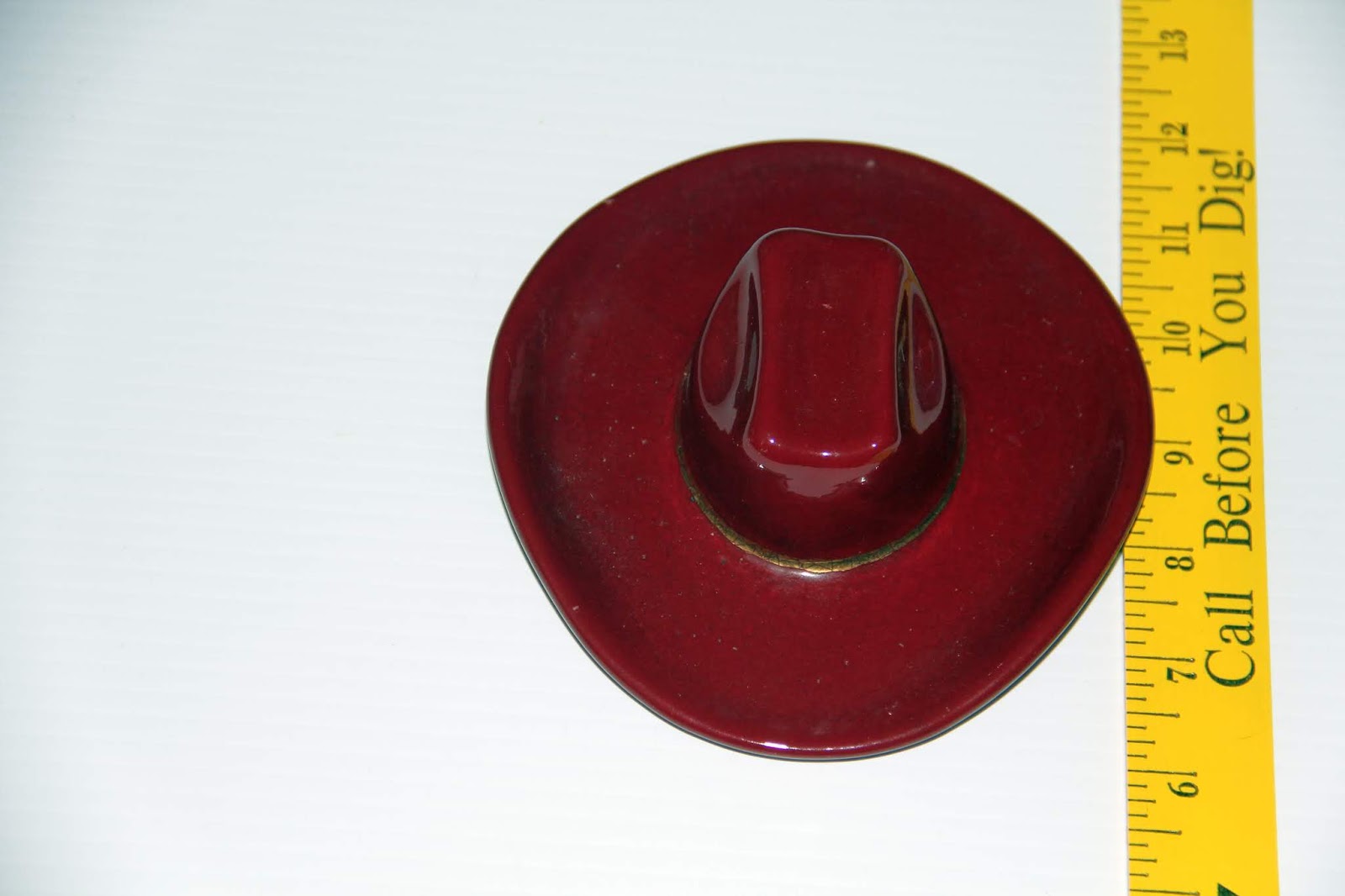
I have included a few different photos of Hycroft pieces, many are not marked but were made by a person that worked at the plant.


As always the joy is truly in the search and the people we meet.  Please add your comments of photos of Hycroft pieces you may have in your own collection.  The photos in the blog are from our own private collection.  We look forward to comments!

The Search Continues...


Friday, 4 May 2018

Cookies Jars..... Lots and Lots of Cookie Jars

There are a couple pieces that I really like and one of them is the cookie jars.  I think it just may the heart warming memories of baking cookies with my grandmothers and my children that make them one of my favorite things.    The cookie jars we have found are in 5 different styles:  there are large and small cookies jars with rope style handles, large cookie jar with no handles, small cookie jar with rope handles, middle size cookie with no handles, middle size cookie jar with lug or ear-style handles.  It is interesting to note that the lid form one cookie jar may not fit in a cookie jar of the same size and color, I wonder is the lids were made to fit the jar or if they just tried the lids in jars until one fit.

Cookie Jar: Small Rope-Handle Style (about 1930-1931)


 Cookie Jar: Large Rope-Handle Style (1931-1938)


The earliest variety appears to be the small rope-handles one, and the only reason for placing it first is because it is the only one that is marked with the “MEDALTA/HAND MADE” stamps. Hand-thrown items were only made for a year or so at the most while moulds were being developed.

I presume that the small rope-handle cookie jars date to early 1931 and perhaps into late 1930. The large ropestyle handle cookie jar likely was developed next, and apparently it was followed by the intermediate sized jars, first the unhandled variety and then the eared-handle variety.

Cookie Jar: Unhandled Style (about 1931-1934)  All the evidence suggests that this style of cookie jar was made only for a couple of years, perhaps being discontinued as early as late 1932 or 1933.
The unhandled variety of cookie jar appears to be simply the lug-handled one without any handles. In fact, most of the unhandled cookie jars that I have examined have the incised lines or scour marks in the clay where the handles would have been attached.  Such scouring was commonly used to ensure a solid attachment of the handles to the main body when affixing the handle with slurry.


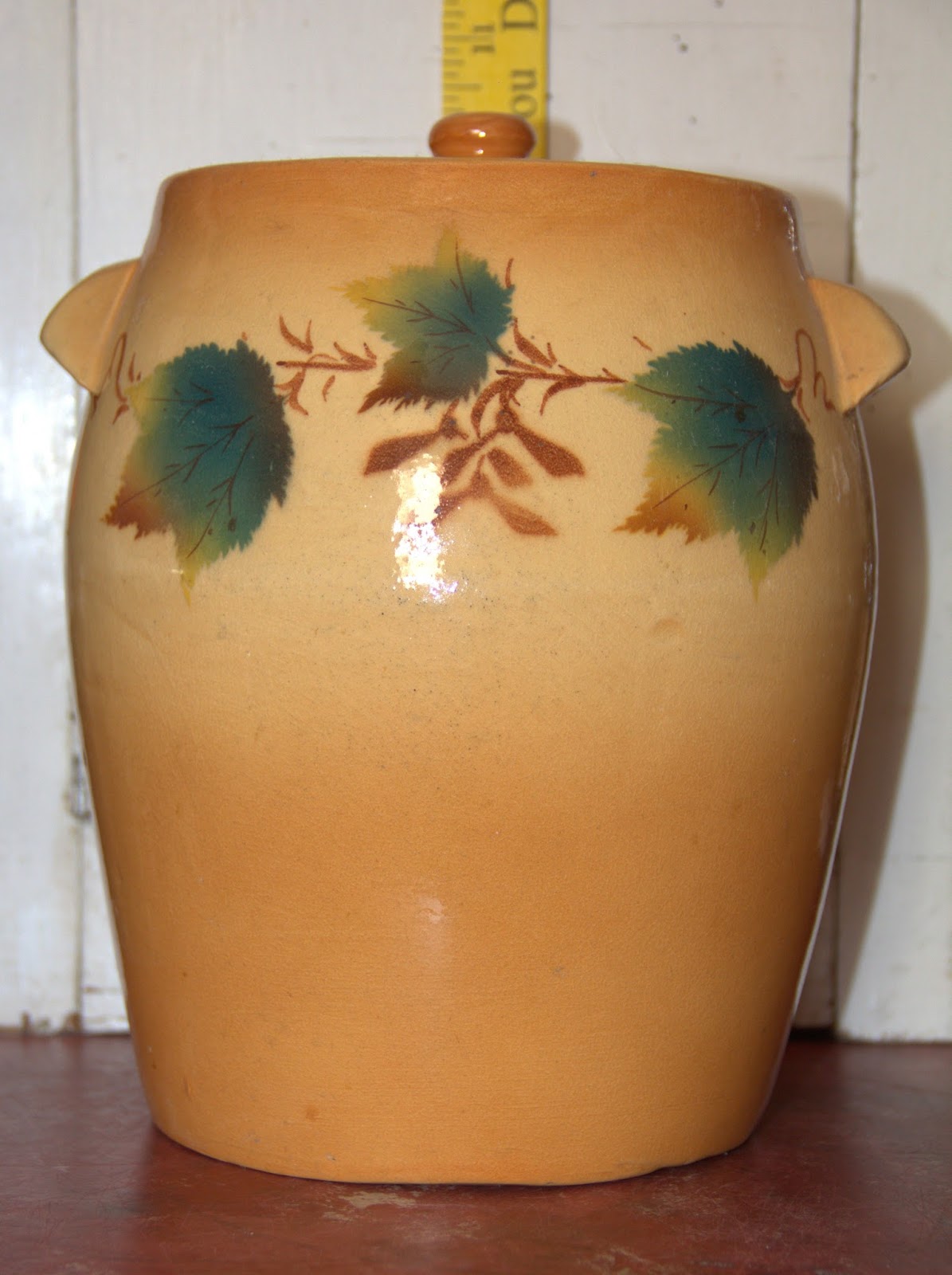
Cookie Jar: Eared or Lug-Handle Style (1931-1945)  The pair of handles attached to this cookie jar are more or less rectangular; and, thanks to being a bit hollow underneath, they are fairly easy to hold, unlike the rope-style that your fingers tend to slip off of.


The following is a list of the Medalta named patterns:

   45 apple blossoms on a blue background
· 46 blue bells on a yellow background
· 47 black-eyed Susan on a pink background
· 48 small black flowers on a black background
· 49 tulips on a green background
· 50 tulips on a mauve background
· 57 plums on a yellow background


· 59 Dutch pastoral scene in blues and black with features accented with white
· 60 cornflower on an orange background
· 67 wide band with white and red stenciled flowers on an orange background
· 69 wide band with blue stenciled flowers on a green background
· 71 wide band with blue stenciled flowers on a blue background
· 73 wide band with orange stenciled flowers on a yellow background


I was told by someone that was a long time collector that the rope handles were hand made by one person before they were made in a mould.  He told us that the person making the rope handles would stay late and make enough to be used the next day, that was the way to ensure that they were all the same.  I imagine that once they started making them in a mould they could be made by anyone and still have the uniformity they were looking for. 


We found a lid that is very different from anything we had ever seen and were looking to see if it was "real" or is someone had it made it much later.  The decoration on the cookie jar is #45, and the lid matched in color, texture, weight of clay...but we had never seen the shape before.  We were told by the collector that everything about the lid matched and likely someone was playing with moulds and made a different lid for a cookie jar for themselves.  I wounder how more pieces will show up that are like that?


It is hard to find a cookie jar with a lid and I would guess that even now the lids get broken and banged up leaving the cookie jar with no lid.  I suspect that cookie jars in the 1930s were used to hold cookies and not just sit on a shelf to look at like they are now.

I often wonder how it is possible that some of the early Medalta pieces are in such pristine condition.  the glazed ones are able to weather time much better that the lacquered pieces. 


The photos of cookie jars are from our own personal collection. 


The information in Italics is copied with permission of the writer.


Tuesday, 10 April 2018

Albert Potteries Ltd .....

Albert Potteries Ltd (Wyatt's Company) : 1931-1938


Alberta Potteries was established by Jesse Wyatt in 1931 in Redcliff with the financial help of local area ranchers.  In the short time Alberta Potteries was in production they produced chicken fountains, spittoons, bean pots, pudding bowls, meat pie pans, casseroles, custard cups, barrel shaped cookie jars and at least six different pitchers, two ashtrays, three styles of teapots and over six different styles of mixing bowls.

By 1936, with the tough times of the depression, Jesse Wyatt had enough and sold Alberta Potteries and returned to Eastern Canada.


Alberta Potteries Ltd (Yuill's Company): 1941-1966

The Alberta Potteries under Yuill's ownership started making jiggered mixing bowls in several sizes.  In time they started to produce crocks, and an artware line that included four or more styles of vases, a bulb bowl, a rabbit shaped planter a rectangular shaped planter and set of log shaped planters.  They also produced housewares such as baking dishes, bowls, casseroles, ashtray, baking dishes and even colored dishes.  Malcolm McArthur joined Alberta Potteries to manage the pottery, during his time there he developed the "Birch Bark" pattern bar-be-que set.  It is not know when Yuill gave up Alberta Potteries but Malcolm McArthur left in early 1958 to start his open his own pottery.


This webpage has illustrations of the stamps used by Alberta Potteries:  https://journals.lib.unb.ca/index.php/MCR/article/view/17142/22847

We use books written by Ron Getty:  The Kilns of South Eastern Alberta, Know Your Medalta: Stamps and Other Markings A Guide to Dating Products and Know Your Medalta Vases, all the books have notes in them to help us remember anything extra we have seen or pieces that we have.  We also use Medalta Stoneware & Pottery For Collectors by Richard & Jean Symonds. We have several others but use these books the most, almost on a daily basis, they are always close at hand and travel with us all over the country.


The Kilns of South Eastern Alberta has information and timeline about all the kilns in south eastern Alberta.  It is very interesting to read how the people in the different companies moved around and the products they produced.  We were lucky and when we bought our reference books two of them were available at the Medalta Museum and the other one we found on eBay.

Talking to other collectors, touring the museum in Medicine Hat and looking at other collections and handling pieces is the best way I have found to actually learn about what it is we are collecting.  We have found other collectors very willing to share their knowledge and stories with us.


The history of the pottery companies in Alberta is interesting as are the varied products they made.  It is easy to imagine the more utilitarian products like crocks, butter churns and pitchers in our grandparents homes, but through those tough years of the depression I am sure it was a hard sell to get some of the artware products into peoples homes.  Perhaps that is why different businesses gave away decorated pieces, so that everyone has a beautiful piece of pottery to look and bring cheer to their homes.

And the Search Continues.........